
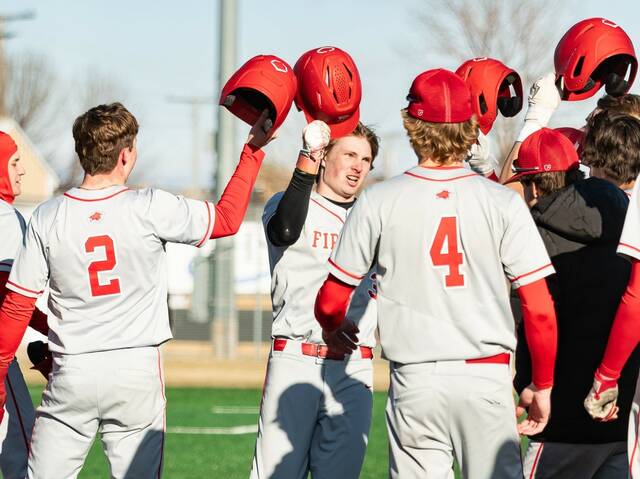
All in all, despite numerous weather postponements and cancelations, this season has been going pretty well for Devils Lake baseball. As of Thursday, the Firebirds have a 9-5 Eastern Dakota Conference record that essentially puts them in a tie for third place.
Ahead of the last stretch of the regular season, I thought I would take a closer look at the numbers.
The most remarkable thing that immediately sticks out is how, despite graduating a wealth of talented seniors, Devils Lake’s offensive statistics have actually gotten better. The pitching stats are better, too, despite graduating some valuable senior pitchers. This year’s group may be relatively less experienced, but the players are getting it done against some strong EDC competition.
Let’s take a closer inspection.
Lineup
The Devils Lake offense — not counting the postseason — hit .273 with a .709 OPS last year.
Not only are those numbers better this year, but the peripherals are, too. As of Thursday, with six EDC games still to go, Devils Lake is hitting .295 as a team with a .741 OPS. The Firebirds are walking 12.9% of the time compared to 10.6% last year. And they’re only striking out 13.6% of the time compared to 17.4% last year.
That’s despite losing Fausten Olson, Trason Beck and Hunter Remmick — three seniors who hit .300 or better on the 2025 team.
So who have been some of the biggest players to step up?
For starters, Devils Lake has gotten a big boost from sophomore Ben Brodina, a first-year varsity starter. He wasn’t even on the team last year, and now he’s one of its best hitters. In 42 plate appearances, Brodina is hitting .412 with a .500 OBP, which are both team-best marks. His sample size is just slightly smaller than some of the others because he was out sick for one of the doubleheaders.
Brodina is tied for the team lead in RBIs with 14. He’s also added positional versatility, mostly playing outfield while occasionally appearing at catcher. His strong arm plays pretty much anywhere.
The Firebirds have also seen improvements from a few players who were already varsity starters. Mason Palmer’s turnaround, in particular, has been night and day. The Jamestown commit got it going last summer, but he started the 2025 spring season in a big slump. He hit just .220 with a .624 OPS last spring. He’s now been Devils Lake’s most productive hitter with a .372 average and 1.016 OPS. Palmer has consistently hit hard line drives at the plate. He leads the team in hits, doubles and OPS, and he’s tied with Taydon Triepke with 10 runs scored.
Speaking of Triepke, the senior left-handed bat has been a mainstay in the two-hole. In the past, Triepke would often bat ninth or just play the outfield. He now leads the team in walks with 12, and his .472 OBP is third behind only Brodina and Palmer. Triepke is walking more than 22% of the time while striking out under 10% of the time. Overall, he’s hitting .289 with a .787 OPS.
Will Heilman is another upperclassman who’s improved his game. Heilman was a starter last year with a moderate .262/.313/.295 batting line. He’s hitting .310 this year with an .816 OPS. His .429 slugging percentage is second on the team, boosted by his first high school home run.
Heilman’s approach has improved significantly. His struggles last year were fueled by a walk rate of just 1.5%, along with a strikeout rate of almost 24%. He’s flipped those numbers on their heads. He’s walking more than 12% of the time this year while striking out about 6% of the time.
Heilman is tied with Brodina for the team lead in RBIs.
At the top of the order, Max Palmer has been his same old consistent self, hitting around .300 all year. Palmer almost never strikes out, with just one punchout in 52 plate appearances (1.92%).
So, a top five of Palmer-Triepke-Palmer-Heilman-Brodina has worked wonders for Devils Lake.
The bottom of the order has been less consistent, but has still provided contributions. Cayden McCarthy has heated up recently, raising his average to .275 with a .383 OBP. The only knock on him is his strikeout rate, which is approaching 32%.
Easton Kraft started slow but has five hits in his last nine at-bats. In the past, he’s proved himself as a solid contact hitter with power to the gaps, and he’s starting to get it going. He’s walking 10% of the time and still has an OBP well over .300 despite his early-season struggles.
Alex Hammond has been the Olson replacement in center field. Still just a sophomore, Hammond’s bat hasn’t fully gotten going yet, but he covers the most ground of any Devils Lake outfielder and has made a seamless transition to his new starting position on varsity.
Tayven Wiberg has typically been rounding out the lineup in the nine-hole. Another first-year varsity starter, Wiberg has looked comfortable at this level. He’s walking (13.2%) more than he’s striking out (10.5%), and he has a .342 OBP.
Players like Jaxon Strong and Henley Driessen, while not starters, have taken advantage of their opportunities and chipped in. Driessen is one of three players on the team who’s hit multiple doubles, despite getting less playing time. Strong and Driessen have combined for nine hits in 29 at-bats, each with an OPS well above .800.
Altogether, Devils Lake has lessened the blow of losing last year’s seniors by getting help from some new varsity players and seeing a team-wide improved approach.
Pitching
While the 2025 team’s offense slumped at times, the pitching usually kept them in it.
Remmick, Parker Brodina and Ben Larson each had a sub-3.00 ERA in the starting rotation. Remmick’s was 1.27. All three of them graduated.
I wrote before the season about how this would open a door for the talented Mason Palmer to finally get some substantial innings. And he’s been exactly as advertised.
Palmer is dominating to the tune of a 1.35 ERA over a team-high 20 innings. He’s collected 31 strikeouts (13.95 per nine innings) compared to just four walks (1.8 per nine innings). He’s throwing more than two-thirds of his pitches for strikes. His WHIP is 0.70, with only 10 total hits allowed. He’s been as good as one could have hoped.
While the No. 2 and 3 starters — Heilman and McCarthy — don’t have ERAs as sparkling as last year’s, they’ve more than held their own as well. And Devils Lake’s team ERA as a whole is lower, at 3.56 compared to 4.41.
Heilman’s ERA is 4.74, and McCarthy’s is 4.24, but they’ve each had one bad inning that’s inflated their numbers. They’ve each been largely reliable aside from a bout of shakiness early in the season.
They’re each throwing harder than they have in the past, too. While Palmer is chasing 90 mph, Heilman and McCarthy are cracking the 80s. The increased velocity has led to better strikeout numbers. Heilman’s strikeout rate is right up there with Palmer’s at 13.74. McCarthy is averaging one strikeout per inning.
This is a different formula than last year. Pitchers like P. Brodina, Remmick, Larson and the old version of Heilman relied on inducing soft contact. They all had low strikeout rates last season. Devils Lake, as a team, struck out just 6.39 batters per nine innings last year. That number has skyrocketed to 10.88 this season. The staff as a whole has been more dominant.
The No. 4 starter is B. Brodina, though he’s also been mixed around with players like Riley Brenno-Quale and Strong. The sample size is still fairly small on Brodina, but he’s been good, with a 2.61 ERA over 10 1/3 innings with 11 strikeouts.
Out of the bullpen, Triepke has been reliable as always, with an ERA in the 3.00s over 10 1/3 innings. Max Palmer has added 4 2/3 innings with one earned run allowed.
The bottom line is that pitchers like Heilman and McCarthy may be less polished than Remmick or Larson were as seniors — but they’ve been more dominant when at their best, with less reliance on the defense to get outs.
Led by a nearly untouchable Mason Palmer, it makes for a pretty solid pitching corps that likely hasn’t even hit its ceiling yet.
While Devils Lake’s strikeout rate is way up, the walk rate is nearly identical at 3.96 compared to last year’s 3.91. The pitchers’ strike rate as a whole is almost 2% better than last year’s, and the staff’s WHIP is about .06 lower.
Much like on the offensive side, the pitching staff’s peripherals are, overall, better than last year’s. Better peripherals are more conducive to long-term success.
That’s despite a roster that might have looked worse on paper, given all the talent that graduated.
The Firebirds still need to bring their best for the postseason, though. Last year around this time, they were pitching it as well as anyone in the state, but their offense let them down when it mattered most. They didn’t score a single run in the EDC tournament.
With a new-look squad and improved season stats, Devils Lake is on its way to reversing course.
Leave a Reply