
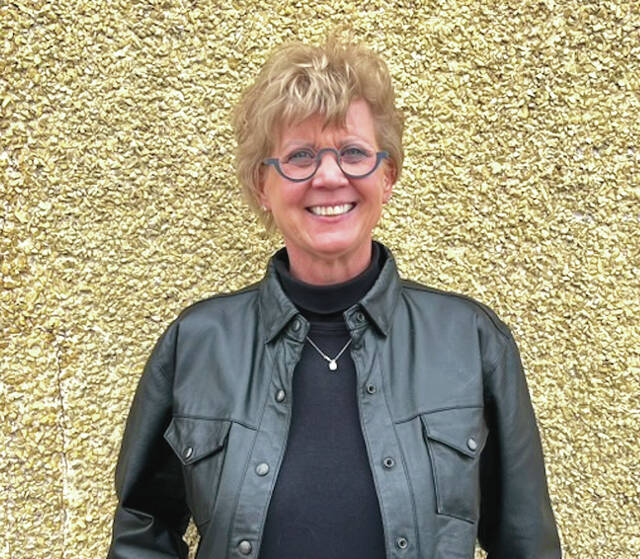
Commissioner Sheri Haugen-Hoffart of the North Dakota Public Service Commission wants to spread the word across North Dakota about the important work done by the state agency. She is one of three commissioners currently serving on the PSC, along with Jill Kringstad and Randy Christmann, who is the current chair.
Established before North Dakota even became a state, the PSC currently oversees the varying degrees of regulation related to electricity, natural gas and natural gas pipeline safety, land management, railroad safety, telephone companies, wind tower and power plant management, management of all commercial weighing and measuring devices, safe digging enforcement, coal mine reclamation, and announces public hearings related to the above concerns.
“Lawmakers for Dakota Territory established a Board of Railroad Commissioners in 1885 to oversee the railroads, sleeping car companies, express companies and telephone companies,” Haugen-Hoffart said. “The North Dakota Constitution retained this board (then called the North Dakota Board of Railroad Commissioners) and entrusted it with powers and duties to be described by law. In 1940, the board’s name was changed to Public Service Commission.”
Haugen-Hoffart added that every state in the U.S. has some type of commission or organization that provides oversight of public services. While in North Dakota, the commissioners are elected to the office, in other states they may be appointed by the governor. “And we regulate different things,” she said. “Some states regulate Ubers.”
Haugen-Hoffart described her daily workload as very interesting. “We can do everything from a siting case of a transmission (line) or a pipeline,” she said. “I could be reviewing a damage prevention case. It is such a wide variety of what we can do on a day-to-day basis.”
“We’re under timelines to make decisions … to ensure that we’re meeting all our regulatory obligations,” she added.
Haugen-Hoffart said that a new case is like an application. “So, let’s just say if one of our (regulated) utilities wants to raise their electrical rates; they put together what they call is an application, and once they’ve completed that, they have all the information that they need and they know we need as a commission. Then they file that, so that’s an application of electric rate case. A siting case might be for siting a (new) transmission line, or a pipeline, or a wind farm, a solar farm.”
Another example of what falls under the purview of the PSC was when, earlier this month, Governor Kelly Armstrong proclaimed April as Safe Digging Month in North Dakota, leading the PSC to remind state residents of the potential dangers and consequences of digging without first clicking or calling 811. “Call before you dig,” Haugen-Hoffart said. “If you don’t know what’s underneath, call. Within two days, they’ll be out there to site it, you know, put the (flags) in, and then it’s good for 21 days. So, if you don’t get to it until the 15th day, you’re still fine.”
For those who don’t call before they dig, it could lead to another aspect of PSC regulation: damage prevention enforcement. “If you don’t call, and you damage a pipeline underneath, and you’re like, oh, I think I hit a gas line, you have to call (811) right away, but then it’s like the assessment of that damage. … So, then the damage prevention case, a complaint gets filed with our office and they investigate it based on the person who’s filing the complaint, all the information that they have, where they feel a violation occurred and then we work with the person or the company that maybe violated it.”
Haugen-Hoffart said that most of the time, consent agreements are often used to address violations of regulations, and the commissioners can determine whether to approve them. Cases brought before the PSC are only discussed between the commissioners during hearings and open meetings that have been noticed to the public. “Anytime an application comes before us we call it an open case,” she said. “As commissioners, we cannot talk to the company about the case, nor can we talk amongst (ourselves) about the case.”
Some cases require that public hearings are held in the affected communities. “We have what we call public comments, and we have the public come up, either in support of it or why they’re against it,” she said.
Even the oversight of weights and measures fall under PSC jurisdiction. “Next time you’re at a gas pump, look and see if there’s a North Dakota Public Service Commission sticker there that that pump has been certified,” Haugen-Hoffart said.
She wouldn’t describe the milestones in her time on the PSC as challenges, per se; she simply follows the precepts of her position to regulate. However, she admitted that siting certain cases has been “intense.”
Haugen-Hoffart has been serving on the PSC since February 2022, when she was appointed by then-Governor Doug Burgum and later elected by voters in November of that same year.
When asked what led Haugen-Hoffart to her current position, she cited her experiences in serving on the board of directors of Capital Electric Cooperative, starting in 2010 and becoming its chair in 2020. She also previously chaired the board of Central Power Electric Cooperative; a wholesale power supply and transmission cooperative whose six-member co-ops include Capital Electric. In both instances, Haugen-Hoffart served as the first female board chair.
“So, I was learning about generation, transmission and distribution,” she said, adding that even though cooperatives are not regulated by the Public Service Commission, there were related matters. “The whole energy area started to fascinate me.”
Now, Haugen-Hoffart wants to make residents more aware of what the Commission does. “One of my goals is to go out and inform the general public what we do for you,” she said.
Leave a Reply