
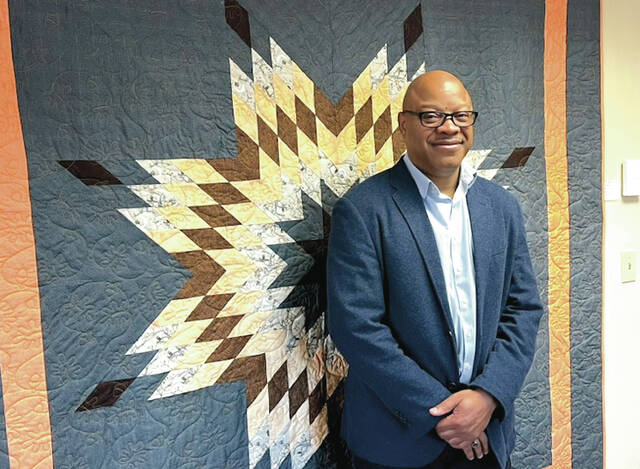
FORT TOTTEN, N.D. – When Dr. Steven Smith first came to Cankdeska Cikana Community College (CCCC) 16 years ago, it was as a professional tutor. Since that time, he has steadily risen through the ranks of the faculty and will have been president of the college for two years this August.
Originally from Clayton, North Carolina, Smith joined the Army after graduating high school, eventually earning the rank of specialist and becoming a supply clerk, which is where he developed an interest in accounting. “I served in Germany from 1986 to ’92, so I was there when the Berlin Wall came down,” he said, adding that he was struck by the immediate change as the wall came down as people came from the East in droves, “seeing all the little cars on the Autobahn.”
After his time in the Army, he attended college, pursuing a degree in accounting, first at Johnston Community College in his North Carolina hometown, then at Shaw University in Raleigh. “Oldest HBCU (Historically Black College/University) in the South,” he said with a proud smile, adding that he eventually earned a bachelor’s degree with an accounting focus, and later an MBA with an accounting concentration.
Smith then worked several years with the North Carolina Department of Corrections, first as a correctional officer and quickly advancing to the rank of captain. However, his ambitions had always been rooted in education. “I always wanted to teach,” he said. “That was my end goal to eventually retire and teach.”
His career shift to education began when he moved to North Dakota. “I followed my significant other here,” he said with a laugh. “So that’s how I ended up out here.”
In a way, Smith’s Army service prepared him for the move from the warmer climes of North Carolina to winters in the Midwest. “Having spent six years in Germany, that was preparation for this,” he said. “The temperature is not too far off, the snow and everything.”
As his wife pursued a career in social work based in Grand Forks, Smith came to work at CCCC, first as a professional tutor. “And then from there, I went to student support services advisor,” he said, adding that he joined CCCC’s faculty and taught a class while continuing his studies at University of Mary in Bismarck, ultimately becoming a Doctor of Education, with a focus in educational leadership and administration. “And eventually, I became full faculty in 2011, and I taught business and accounting up until I became president.”
Initially, Smith was reluctant to take on a leadership role at CCCC, but he was encouraged by colleagues to apply when the position of president became available, and he’s found it just as rewarding as the job he had when he first arrived on campus. “I was helping folks as a professional tutor, facilitating their efforts at completing a degree, and now as president, I help people, I facilitate the efforts of staff, students, faculty and being able to discharge their duties to the best interests of the student,” he said, adding that he has helped make it easier for people to achieve their best in both roles, albeit at different levels.
Commuting regularly between the campus and his home in nearby Petersburg, Smith also values the working relationships that he has developed since coming to work at CCCC which have become almost like family. “I’ve got so many friends,” he said, “some as close as brothers. … It’s become more than just a place where I work. You know, family, friends and the majority of the people that I interact with, outside of my house, which is very small, is from the community, either here or Turtle Mountain, so it’s become more like the home away from home.”
He said that his time as a soldier helped prepare him to interact with people from different walks of life. “I’ve been in so many different areas, cultures, to where I understand how I’m supposed to comport myself and respect the host who I am staying with while I’m here.”
Smith added that working in a campus setting located on a Native American reservation has provided him with a unique viewpoint. “Being in an environment that’s so culturally focused gives you a perspective as a teacher, not just on the immediate culture, but as you look at broader areas you may end up teaching, you can bring that same focus to wherever you teach,” he said.
“We are a community college in every sense of the word,” Smith said, adding that people have moved away from using the word “community.”
“We are the last ones named as such in the state, and I think that we embody all of that … as a total community college,” he said, adding that the fields of study offered at the college include liberal arts, social work, business, fine arts, as well as trades like construction, technology, and CDL training.
While they offer associate degrees, CCCC also has two-plus-two agreements with other colleges like University of North Dakota, University of Mary in Bismarck and Mayville State University. “We have two-plus-two agreement social work with UND, and I think we have turned out something like 30 social work bachelor’s degree graduates, and I think, a couple of masters’ degrees through our relationship with UND,” Smith said. “We just recently did a two-plus-two agreement, also in social work with U Mary and that was based on a grant that they received.”
One of Smith’s proudest achievements is being one of only five tribal college presidents in the state. “I have told people that working here, in Indian country, specifically is one of the best kept secrets,” he said. “We have staff here who are getting bachelor’s degrees, they’re getting doctorates right now, master’s degrees and we are able to cover that through our professional development funding through Title III.”
“Most of our students come from the community,” he added. “Our education is based on local culture. We have courses that are specifically culturally related: language, culture, philosophy, and I think we have uniquely a great faculty who have been here and present for a lot of years.”
Reflecting on what led him to his current position, Smith felt that education and mentoring have always been a part of his adult life. “I think I have always done that … regardless of where I’ve been,” he said. “Even when I worked with the Department of Corrections … it seems like I was always put in a position to where I was always teaching.”
Leave a Reply