
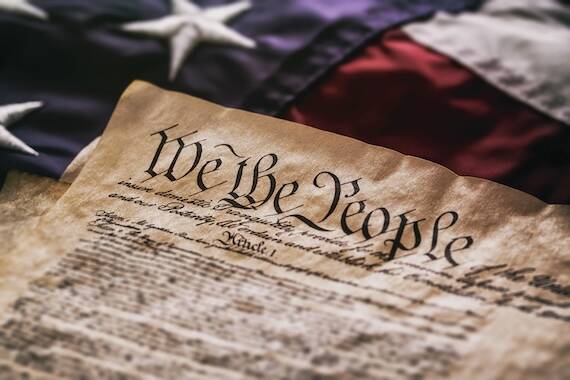
Americans’ deep interest in our nation’s history, super-charged by the fast-approaching 250th anniversary of the Declaration of Independence, has brought renewed focus on the early controversies, personalities and events that launched the American Revolution. The founders, themselves, were quick to identify intellectual influences that shook the tectonic plates of history and triggered the earthquake that produced a republic.
John Adams, who, with Thomas Jefferson and Benjamin Franklin, constituted the “Holy Trinity” of the revolutionary Enlightenment Period, was at the epicenter of the political earthquake. In 1761, Adams was a spectator in a crowded Boston courtroom, drawn by the growing reputation of the brilliant, young firebrand attorney, James Otis, Jr., who was there to argue in what has become immortalized as the “Writs of Assistance Case,” on behalf of outraged, local merchants against the parliamentary statute that authorized sweeping searches and seizures—fishing expeditions— of private property. In a losing cause, Otis had sounded a bold and unprecedented trumpet call: not only was the law unconstitutional, but that it was the duty of the courts to pass such a law into disuse. Otis’s conception of the embryonic doctrine of judicial review, introduced at that juncture for political, constitutional and, indeed, revolutionary purposes, fired the imagination of Adams, who grasped, not only the legal, but the strategic implications of the argument. For a nascent movement in search of intellectual tools to battle British imperialism and somehow strip England of its all- powerful sovereignty, Otis’s radical contentions made him the man for the moment. Adams wrote, rather romantically, “then and there the child independence was born.”
If not in a Boston courtroom in 1761, then perhaps the match was lit with the publication on January 9, 1776, of Thomas Paine’s little pamphlet, “Common Sense,” which wielded a stunning impact on the Continental Congress and the minds of colonists, up and down the eastern seaboard. When Adams returned to Congress a month later, the pamphlet was already in its third printing, having exceeded 100,000 copies, and having ignited a fever for independence. In Common Sense, Paine attacked the very concept of hereditary monarchy, burned its intellectual scaffolding to the ground, named King George III a “royal brute,” and unleashed a call to arms and American Independence. Paine ripped away the mask from indecision and asked, “Why is it that we hesitate? The birthday of a new world is at hand.” Paine sensed the universal appeal of American independence. “The cause of America,” he wrote, “is in a great measure the cause of all mankind.” Adams agreed. He wrote to his wife, Abigail, that he expected Common Sense to become the “common faith.”
Adams’s great revolutionary work, which would change the face of the nation, lay ahead. On May 10, in the confines of Congress, he introduced the bold recommendation that every colony should draft a new constitution to replace the existing British charters of governance. Five days later, he stepped forward to introduce a preface to his resolution. On May 15, Adams set forth a list of grievances, which documented King George III’s failure to answer the colonists’ petitions for reconciliation. In conclusion, it was the king who had effectively abandoned, that is, declared the independence of his former American subjects. Accordingly, he called upon the “Assemblies and Conventions of the United Colonies” in which no government sufficient to meet the exigencies had been established, “to adopt such Governments” to promote that happiness and safety of their constituents.
With an author’s pride, Adams immediately described to a friend that his resolution was “the most important Resolution that ever was taken in America.” Until the end of his days, Adams did not waver from that belief. In his view, the call for the creation of state governments constituted the ultimate act of American independence. It was a completely natural and logical response to the fact that the King had repudiated the colonists.
In the annals of history, it is true that Thomas Jefferson’s draft of the Declaration of Independence has worn the crown of achievement in the minds and imagination of Americans. It is also true that Jefferson’s majestic writing rode the surging tides of voices—from Otis to Paine to Adams— that demanded separation, independence and revolution. In a plea to the world, the “United Colonies” gave birth to a new idea, a republic, in which the people, not a king, would govern.
This column is provided in part through NDNA.
Leave a Reply