‘The Mail Must Go Through’
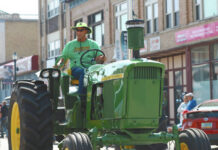
“I will carry the banner for my hometown, Drayton,” declares Donald Holler. The Holler family has carried more than the banner for Drayton. Donald’s father began carrying its mail in 1926. “In the winter, they had to hire horses to make the route,” Donald says. “One time he owned an old snowmobile and used [it] to complete the route.” Donald was initially appointed part-time postal clerk but was drafted for military duty in 1951 and became a construction foreman while serving in Korea.
Following his discharge, Donald returned to Drayton where he served the community by working as a clerk, postmaster, and part-time inspector during his 35-year career at the U.S. Postal Service. “The post office was an excellent job,” Donald says. “When I worked for the postal service, I knew everybody in town. I knew every kid in town. I could name most of the dogs.”
He has lived in Drayton his entire life except during military service. His wife, Doris, was also from the Drayton area. Doris died in 1994 of multiple myeloma. “[Marrying Doris] was the best decision of my life,” Donald states. “Together, we lived a good life and had a good son.
“I’m proud of my son, John, who graduated from West Point Military Academy,” says Donald of his only child. “John was a good student and no problem to raise. Other than when he had sports, he would come home from school and do his homework on his own.”
When asked what positive influences were in John’s upbringing, Donald replied, “Doris’s mother stayed with us in the winter, and she did a lot of reading to him, and my folks being close was a great influence. Also, my wife was a schoolteacher so John had a good home environment. John had a very good relationship with grandparents.”
As to Donald’s activity now, “I go downtown for coffee in the morning and afternoons. I would like to stay in Drayton with no plans to move elsewhere. Everything I need is here.”
— Donald Holler, Interview: September 13, 2006, County: Pembina, City: Drayton
’Seeing God’s Creation on the Farm’
Lois says, “I grew up on the farm six miles southwest of Almont. They called them the Ramsland Hills. I went barefoot a lot when I was little. I wasn’t quite two years old, but I could run anywhere without shoes, and it wouldn’t bother me. Mother had bought shoes for me to go to my dad’s niece’s wedding. Come to go to the wedding that day, she couldn’t find my shoes. I don’t know if they took me to the wedding or not without shoes, but they found them the next spring out in the field.
“I was born on August 4, 1932. That October my dad fell off the horse and broke his leg, so he was in the hospital for an extended period. There was no casts at that time. So he was in traction in the hospital. My mother took their cows and went to her folks in Sims. She stayed there and milked the cows. [Dad] had a limp and a crooked leg afterwards. When he come back home, his dad talked him into buying a farm. Mother was unhappy. But we moved into that house. I’m sure there was hardly any income. When I think back of it, we were poor, very poor, but at those times we never thought about it, because we had food and we had clothes.
“It was very important to my mother we attend church regularly. When we were little, Mom read the Bible stories to us. Mom always talked about her faith with anybody who would come. We had lot of company, and they didn’t leave our place without [a meal]. We were eight miles from church but attended every Sunday. Mother played the pump organ in church.”
Lois, a registered nurse, married Rhine Klaudt and lived on a farm near Linton. They had five girls. After Rhine died, Lois married Lester Van Beek from that area. Upon Lester’s death, Lois moved to West Fargo.
“Living out in the country and seeing God’s creation—births of the animals—it’s just God’s miracle. I miss the sun rising and the sunsets. On the farm you’ve got both.” For Lois, what are the greatest virtues she learned in life? “Faith in God and family.”
— Lois (Larson) Klaudt Van Beek, Interview: August 3, 2018, County: Morton, City: Almont
‘Do What You Want to Do’
The path to banking was pretty clear cut for Robert Wurl. “I guess I always had the thought that I wanted to do something business-related, probably not farm. My brother is the oldest in the family and always liked to farm, and so I didn’t really think that was an option. It wasn’t as if I hated it, but it wasn’t really something that I aspired to do. As I went to school and got older, I enjoyed bookkeeping and accounting classes, so that’s what I chose to pursue.” Robert is now president and CEO of Lincoln State Bank in Hankinson.
Robert was born in 1958 in Hankinson and grew up on a farm “Everyone is not cut out to get a four-year degree, or beyond that. Everyone’s not even cut out to go to a tech school for two years. It’s more about doing what you want to do—identifying what that dream is and going after it, and figuring out what you need to achieve to get there, and building that circle of friends and support to help you achieve that. Growing up in a small community, success doesn’t mean going to the big city, necessarily.
“Success is being content in where you are physically or are spiritually. No one is probably ever content with where they are financially, or very few people. What I’ve seen is that the more money people make, the more they spend. There are a few exceptions to that, but I think success is just being content. Personally and organizational wise, we learned the hard lessons very recently about having your health. You know, when you’ve worked side-by-side with someone for 34 years and they’re a year older than you are and you’re going to their funeral, that’s something that’s difficult to do and that puts things into perspective.
“You can buy every automated piece of machinery that you can find, and have five homes and travel in between them and so forth, but if that doesn’t satisfy your inner self, you’re still unhappy. You’re not content, and you’re going to keep spending money to try and find it.”
— Robert Wurl, Interview: July 16, 2014, County: Richland, City: Hankinson
(Editor’s Note: These profiles of North Dakota residents were collected by author James Puppe between 2004-2018, covering 617 subjects and 113,000 miles. He has given permission for his book to be serialized in North Dakota Newspapers at no charge. To find out how you can read the entire collection of Dakota Attitude profiles go to dakotaattitude.com.)