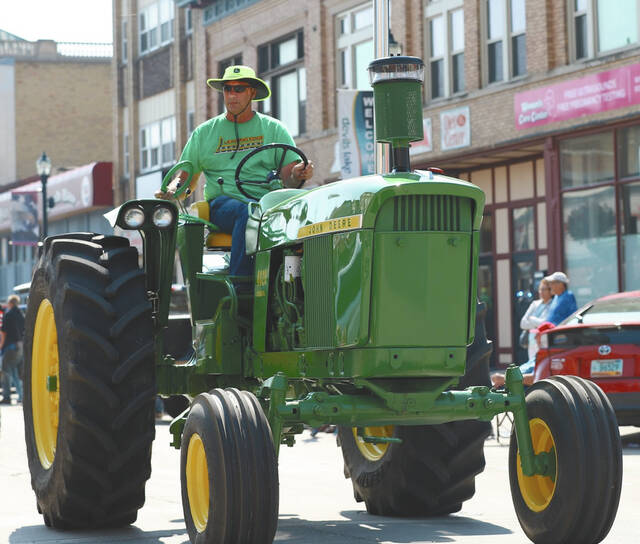
This vintage tractor, shown here in a 4th of July Parade down Main Street of Devils Lake in recent years, demonstrates the wide front tire placement in some John Deere Tractors. (Photo Louise Oleson, DLJ)
Years ago farmers planted a lot of their fields in the spring with a plow, packer, and a small drill. The drill was the width of the plow. It was called pony drilling and the name pony referred to the small drill used. You could turn the soil over and seed it all at the same time. Very efficient!
My Dad had 2 pony drill outfits. One was a 3 bottom plow which was pulled with a wide front A John Deere tractor and the other had a 4 bottom plow and it was pulled with a 70 John Deere tractor. Dad drove the 4 bottom pony drill outfit and one of us kids would drive the 3 bottom pony drill outfit.
Plowing a field with a tractor was actually the first use of Auto Steer. When you plowed you had a furrow and you would drive the tractor and put the front tire in the furrow so the tractor just had to follow the furrow. And that was the Auto Steer!
The plow, packer, and pony drill made for a long outfit and as the pony drill was the last in line it was difficult to see if your drill was seeding properly. The drill had a long container on it to hold the seed in and from there the seed would fall into these little cups and from there they would fall down a tube and go into the ground and the small wheels on the back of the pony drill would go over the seed row and pack it in the ground.
It could be difficult to tell from the tractor seat if the seeds were coming into each cup like they should be so you would have to make sure the seed container on the pony drill was emptying into all the little cups. Occassionally you would stop and dig in the ground behind the pony drill to see if there was seed in the ground in each row. This was the most stressful part of seeding grain to me because you did not want to leave any bare strips in the field.
Driving a tractor with a pony drill was actually a good way to spend a day especially in the spring when the sun was shining. We did not have cabs on the tractors and we pony drilled in all sorts of weather. Sometimes in the spring you could still get a snow shower and it would be very cold sitting out there. I remember pony drilling wearing my heavy winter coat, a cap with ear flappers, and warm gloves.
Pony drilling was not a very hard job physically but you did have to pay attention. Not always an easy thing to do for a young teen-ager! The most important part of plowing was getting a straight furrow. If the furrow was crooked the field would look very messy. All the farmers that I knew were very obsessed with making straight furrows. (Especially the Norwegians)
When you started plowing a field you would start the first furrow in about the middle of the field. Starting a furrow was called “striking out”. Quite often my Dad would use a measuring device made out of wood and in the shape of a large triangle which I believe equaled so many rods. You could measure how many acres you had with this triangle. But I don’t remember what the triangle was called. This triangle measuring device has been used for measuring land since homesteading started.
Dad would use it to measure across each end of the field to determine the middle and would then set a visible marker at each end to use as a sight to aim for when striking out a furrow. Sometimes he would use one of us kids as the marker. I guess this was an early version of GPS.
Our fields were not very large like fields are today so you would strike out a furrow in the middle of the field and then along the edges of the field. A wider field though would require more furrows. Whenever we pony drilled Dad would always strike out the furrows himself. The area on the ends of the field where you drove on was called the headland and this was seeded last. Dad would always do the headlands himself too. Dad’ fields always looked nice.
As we became teen-agers Dad gave us more responsibility and would have us pony drill fields by ourselves if he was busy with other projects, When I was in my early teens, the first time I struck out a furrow by myself I didn’t bother with measuring the ends of the field. I figured I could just “eyeball” a straight furrow. Yeah, right!
I took a guess as to where the middle of the field was, then I started on the south end of the field, pointed the tractor to what I thought was straight north, and found an object to sight in on. And I was off making my first furrow. Unfortunately the object I sighted in on was a fence post in a fence line in the pasture and after I made the furrow I realized I hadn’t been using the same fence post all the time as my visual. Apparently every time I looked away when I would look back I would focus on a different fence post. I made the crookedest furrow ever! At first I panicked a little, then finally calmed down and decided the best thing for me to do was to keep using that furrow and to try to straighten things out at the end. But when I was finishing up the field I had 2 furrows and the field came to a triangle. It was pretty messy! Fortunately though the field was not by a road so no one else could see it but I did learn how important preparation was before starting a project. Actually my Dad wasn’t upset, he thought it was pretty funny!
Something else you had to be concerned with while pony drilling was rocks. The plow could turn over rocks that if the pony drill run over them there could be a lot of damage to it. Sometimes the plow would hook a solid rock which could damage the plow. So there were special hitches for the plow and tractor that if you hit a solid rock the tractor or the plow would stop.
The hitch we had on the A John Deere was I think called a Steinman hitch. Part of it was a chain that was attached on one end on the hitch of the plow, the other end was attached to the hand clutch on the tractor. So if the plow hit a solid rock the chain would tighten and it would pull the clutch back thereby stopping the tractor. The hitch worked great, the only downside to it was that it seems like when the clutch was pulled back it would always slam into your knee!
The outfit my Dad drove though used a different type of hitch in that the plow was attached to a clevis on the tractor and if the plow hit a large rock, the plow would unhitch from the tractor. So instead of the tractor stopping, the plow would stop. Then you would have to back the tractor up to the plow again and lift a rod on the plow to raise the plow hitch up and hook it to the clevis again. You could do all this without getting off the tractor but it was kind of cumbersome. If you were distracted like being deep in thought or day dreaming you didn’t always notice right away that you lost your plow so you would be driving down the field without your plow and pony drill. Kind of embarrassing if anyone was watching!
I think it was in the late 60’s that a wonderful new invention was introduced and it was called the Reiten plow. With this plow when you hit a rock, the plow bottoms were spring loaded so they would flip up in the air quickly skipping over the rock, then go back into the ground and continue plowing. No more stopping everytime you hit a rock. On a very rocky field it was fun watching the plow bottoms go up and down! The Reiten plow was kind of a lime green color, very distinguishable. Reiten was later bought out by Melroe and their color was red. Definitely one of the great farm machinery inventions of all time.
Ever since man first turned the earth over and planted a seed there had been a quest to build a better plow. From the one bottom plow pulled by oxen and kept in the ground by the man behind it, to the steel frame plow, to the sulky plow, and finally to the Reiten plow farmers have always been trying to improve on it.
Farmers have improved the seeding of grain process so much that the plow is now pretty much obsolete. You only find them in yard displays and old time equipment farm shows and events.
In the late 1980’s I had a 6 acre field that I used as pasture for horses and it became over run with the weed wormwood so I decided the best way to control the weed was to plow the field, turn the weeds under, and then spray as needed. I didn’t have any farm equipment so I tried to hire someone to plow it for me. But none of my neighbors had a plow anymore.
Luckily though for me, a fellow who was about my age and who lived in Fargo but he still owned his parents farm and their equipment which included a plow and he agreed to plow the field for me. His farm is only a few miles from me. His name is Brad and I still remember the look of total enjoyment on his face as he plowed my little field. I think he was re-living childhood memories just as I was.
In my stories I write about my Dad’s wide front A John Deere tractor which he bought new I think in about 1947. This tractor was capable of handling 3 bottom plows and was noted for it’s distinctive pop-pop-pop engine sound and was referred to as a “Johnny Popper”. It sold new for about $2,400. There were several versions of the A such as the AR, AO, AI, and AW. According to Farm Collector magazine John Deere sold 320,000 model A tractors, rivaling the Farmall H in popularity. Dad also had a narrow front A.
I am not a farmer and the last time I drove a tractor and did any actual field work was over 50 years ago. But I am a farm boy at heart and I follow farming practices through farm and ag magazines, listening to farm news on the radio and tv, and observing my farmer neighbors. I am also fortunate to have 2 great son-in-laws who are farmers and involved in the AG world and they share lots of their knowledge with me. I am just amazed and impressed at how farming has evolved over the past 50 years. I am very proud of our farmers.
The source for this story is my memories. I cherish the memory of spending the day pony drilling and doing field work with my Dad. I hope you have similar memories. Thanks for letting me share mine with you.