
What Is A Co-Op?
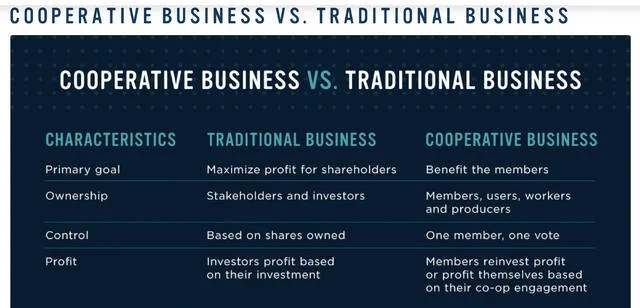
The person or people who own a business determine the type of entity it is. When an individual owns and operates a company, it is often a sole proprietorship. When two or more people own a company, it’s often a partnership. Acompany can incorporate, forming a corporation that is owned by fewer that 100 people (an S-corp) or hundreds or even thousands of people (a C-corp). When the people who use the products and services a company has to offer also own and operate the company, it’s known as a cooperative. Aside from the ownership structure, there are a few other distinct features that set cooperatives apart from other types of business.
The International Co-Operative Alliance defines a cooperative, or co-op, as “an autonomous association of persons united voluntarily to meet their common economic, social, and cultural needs and aspirations through a jointly-owned and democratically controlled enterprise.” In other words, cooperatives are created by people who have a specific need and who are willing to work together to operate and organize a company that will meet that need.
For example, consider rural electric cooperatives (RECs). Some large city power companies may not see running electricity lines to farms and rural areas as a profitable venture. As a solution, farmers might form a cooperative to collectively raise or borrow funds to construct and govern a not-for-profit, private power utility. Every property that uses the power utility becomes a member-owner of the REC, contributing to the management, decisions and maintenance of the utility co-op. This cooperative focuses on improving the community’s quality of life rather than making a profit. Today, RECs power 56% of the American landscape.
How Do Cooperatives Work?
A cooperative might look very similar to any other type of corporation. For example, if you were to visit a grocery store cooperative, it is very likely that it will look like any other grocery store. There will be aisles full of food and checkout registers where people can make their purchases.
But if you were to look more closely, or take a peek behind the scenes, you’d be likely to notice that the food co-op operates slightly differently from a typical grocery store. For one thing, it’s likely that the people who are members of the cooperative, or part-owners of the co-op, are also working at the co-op, stocking the shelves and ringing customers up at the register.
Plus, some cooperatives limit who can shop there or use their services. In some cases, only members of a cooperative can shop at it. Some cooperatives are open to all, but provide special incentives to members, such as a discount on products or services.
Why are people who are members of a food co-op willing to volunteer or donate their time to work at the co-op? In part because of the community focus of a cooperative and the values behind co-ops. Among those values are:
- Democracy
- Self-help
- Self-responsibility
- Equity
- Equality
- Solidarity
People who join cooperatives or who are among the founding members of a co-op often have the same shared values, meaning they are willing to work together toward a common goal. One of those goals is to create a better world by working together and by shifting the focus of the business to place people over profit to build a more inclusive economy.
What Is the Purpose of a Co-Op?
Why do co-ops exist? The purpose of a cooperative is to realize the economic, cultural and social needs of the organization’s members and its surrounding community. Cooperatives often have a strong commitment to their community and a focus on strengthening the community they exist in or serve. When a co-operative does well financially or economically, the community served by the co-op benefits, not just a small group of shareholders.
Co-Op Ownership and Control
The people who benefit from the products or services of a cooperative business own the cooperative business. In the case of a grocery co-op, the people who shop at the store are owner-members. In the case of co-op housing, the people who live in a particular building are members of the cooperative that owns the building.
Just as the stockholders or shareholders of a business have a say in the ownership and operations of a company, the member-owners of a co-op have a say in how the cooperative operates. The difference is that in other types of corporations, the size of their ownership stake influences how much of a say or how much control an owner has over the company. A shareholder who owns 50% of a corporation will have more votes or more control over the operation of the company compared to a shareholder who owns 2% of a corporation.
That’s not the case with a co-op. As equity and equality are among the founding principles of a cooperative, each member-owner of a co-op gets one vote. The opinion of one co-op member does not have more weight than the opinion of another co-op member.
Cooperatives often elect a board of directors. The responsibilities of the co-op board include ensuring that the cooperative is working toward achieving its mission, setting up operational policies for the co-op and hiring any outside managers or other employees.
Members of a co-op’s board are members of the cooperative itself. They are typically elected to the board by a member vote. Some board members also serve as officers, such as president, vice president, secretary and treasurer. Board officers have additional responsibilities and duties, which members can find in the cooperative’s by-laws.