
A special meeting of the Devils Lake City Commission was held at 11 a.m. on Wednesday, Sept. 2 in the Commission Chambers with Mayor Jim Moe and Commissioner Lisa Uhlenkamp absent. Rob Hach, Jason Pierce and Joe Knowski were present.
The meeting was called to order by Vice President Rob Hach as they began discussion about the residential refuse container proposals, rates and fees and the next steps in this transition.
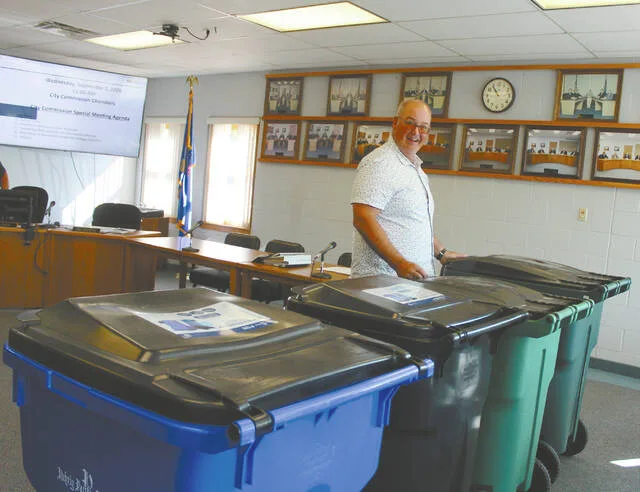
Mike Grafsgaard led with much of the information on the suppliers who had presented proposals. Samples of the different receptacles were also in the chambers of City Hall so the commission could evaluate themselves. Grafsgaard explained that a committee had evaluated the proposals and reported that two manufacturers stood out among the five; Toter and Rehrig Pacific.
The containers were evaluated as to the quality of manufacture, molded containers vs injection manufacture, tipping ease, wind stability and mobility in general. How easy or difficult would it be for a resident to move a container when it was full?
Would older individuals have difficulty tipping them back to roll? Where should the containers be placed on a resident’s property so the truck can access it automatically?
All the proposals came in below the anticipated total budgeted item that had been set aside for this project, therefore the money is already in the budget for the containers and replacement parts plus additional containers of both sizes for new customers or containers in need of repair. The containers will each be identified and actually belong to the city rather than the residents.
Head of the city’s garbage collection department, Corey Erickson attended the special meeting and reported his findings, as well, and that as they transition to the automated collection, there will be a need to educate the public on the proper place these containers need to be located so the new santiation truck can access them easily.
Much discussion ensued from these presentations. Both Commissioners Pierce and Knowski asked several questions about fees and logistics, anticipating what members of the public will be asking or concerned about.
Since there will be an estimated increase to resident’s fees, Pierce made a motion that they table any decision until the City Commission meeting set for Tuesday, Sept. 8 at 5:30 p.m., just a few days down the road. He was concerned that everyone be on the same page with whatever they decide and since two members were not present at this meeting, perhaps they [the commission] should wait until everyone is in attendance and able to ask the questions they have about this issue. No doubt there will be questions from the residents, as well, that they will have to address.
As it stands, now, the favored manufacturer was Toter because of the container’s quality, stability and ease of use. The question remains for residents whether they need or want a 65-gallon container (recomended for users who now only use one 32-gallon garbage can for weekly collection) or the 95-gallon container (recommended for those who now use more than one 32-gallon garbage can). The size of container and number of containers will determine the price their garbage collection bill will ultimately be. Everyone will see a minimal base fee increase, however.
Residents with questions or concerns regarding the automated garbage collection that will be starting in October of this year are encouraged to attend the Sept. 8 meeting in City Hall at 5:30 p.m.
In addition, they also discussed that for the time being the use of the big blue bags for larger items will continue with an increase of $2 to $4 per bag, however, that, too, will be going away down the road. Erickson stated that they may try having a centralized location where residents can bring their blue bags to dispose of those items that cannot go into the rolling container.
That led to a discussion about the city’s recycling center, which they anticipate will also be going away in the future because sources for those recyclables just aren’t available anymore. Eventually the only item easily recycled that will remain is corrugated cardboard, unless something changes.
Commissioners observed that changing from the current process to the automated process of collecting residential garbage would save the city money in the long run, because one person can operate the new automated truck, saving on the cost and difficulty of finding and hiring personnel, but initially setting up the new process will be a challenge for everyone, residents and city services, as well.
The hour-long meeting brought out many questions and concerns that will be further discussed in depth at the Sept. 8 meeting.
To listen to discussion and decisions made at this meeting, go to the city’s website at www.dvlnd.com or visit the City of Devils Lake’s YouTube channel to view recorded meetings.